JavaScript Temporal Intro
What is JavaScript Temporal?
Temporal is the new standard for date and time in JavaScript.
New Temporal objects were designed to replace the old Date object.
Unlike legacy Date, Temporal objects are immutable and provide first-class support for time zones, daylight saving time, date arithmetic and non-Gregorian calendars.
Why Was Temporal Created?
The Date object was created in 1995 and has some design issues that still cause bugs today.
For example, months in Date are zero-based, which is confusing.
Another problem is that many Date methods change the same object (mutation), which can create unexpected results.
Example
// Create a Date
let d = new Date(2026, 5, 17);
// Add 7 days
d.setDate(d.getDate() + 7);
// Here the original date (d) is lost
Try it Yourself »
Temporal was created to solve these issues with clearer object types and predictable behavior.
A Simple Temporal Example
With Temporal, you can get today's date and add days in a clear and safe way.
Example
// Create a Temporal object
const today = Temporal.Now.plainDateISO();
// Add a duration
const nextWeek = today.add({ days: 7 });
Try it Yourself »
Compare With Date
With JavaScript Date, you only have one type of date object.
Separate Objects
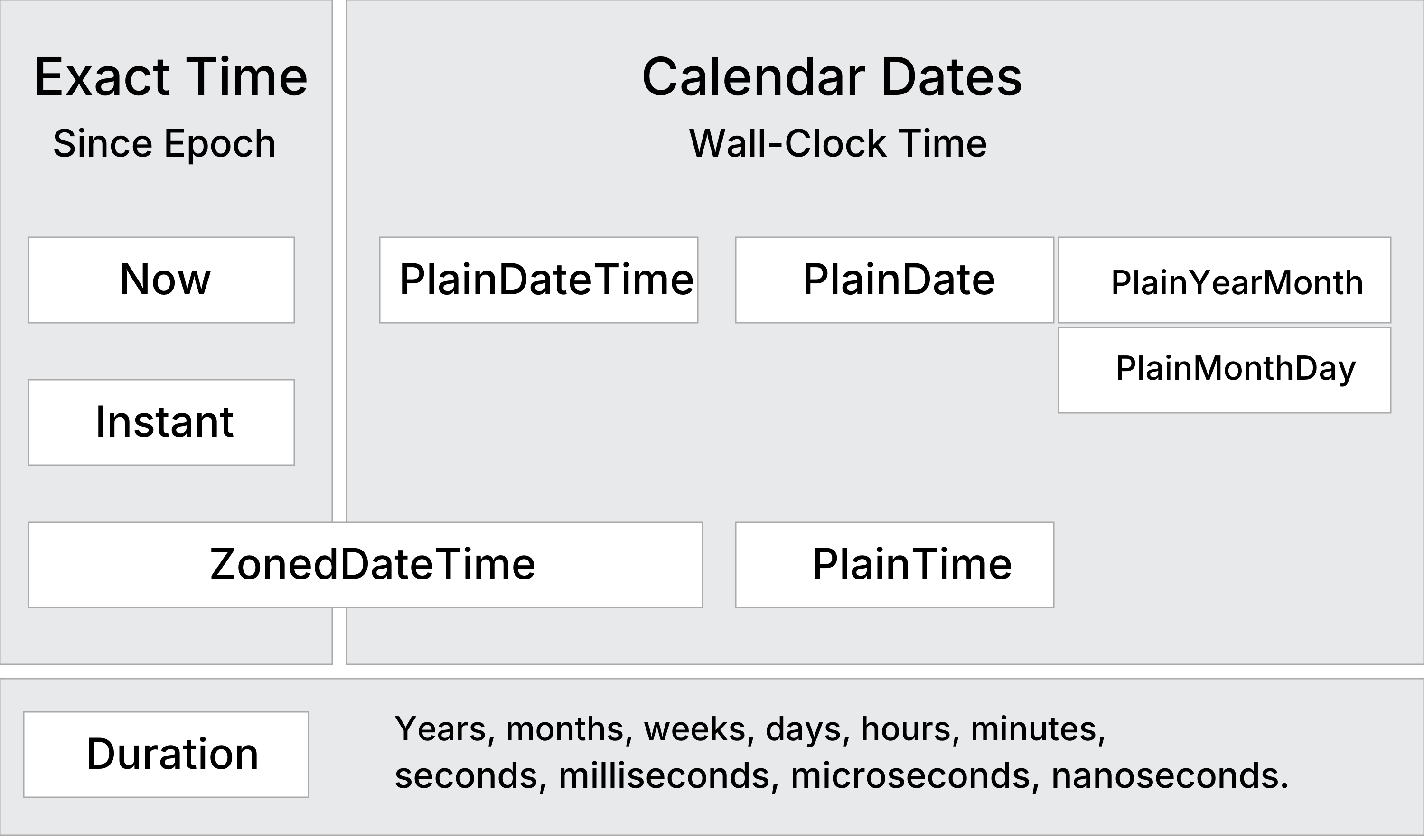
Temporal gives you separate objects depending on what you need:
Instant - Exact moment in UTC
PlainDate - Date only
PlainDateTime - Date and time only
ZonedDateTime - Date and time with zone
When to Use Each Object
Instant - For timestamps and comparisons
PlainDate - For birthdays and calendar dates
PlainDateTime - For local scheduling tasks
ZonedDateTime - For time zone-aware apps
Temporal Objects are Immutable
Temporal objects are immutable, which means they cannot be changed after they are created.
Temporal objects return a new value instead of modifying the existing one.
Temporal Dates are DST-Safe
DST-safe arithmetic ensures time calculations (addition and subtraction) remain accurate across Daylight Saving Time (DST) transitions, preventing 1-hour errors.
It involves using timezone and calendar-aware objects (ZonedDateTime) that understand local clock shifts.
Temporal Dates Uses RFC 5545
RFC 5545 (Internet Calendaring and Scheduling Core Object Specification), is the industry standard for exchanging calendar and scheduling information.
It allows different systems (like Google Calendar, Apple Calendar, and Microsoft Outlook) to communicate seamlessly.
JavaScript Date vs Temporal
| Feature | Date | Temporal |
|---|---|---|
| Time zone support | Limited | Built-in |
| Immutable | No | Yes |
| Date-Only Type | No | Yes |
| Time-Only Type | No | Yes |
| 1-Based Months | No | Yes |
| DST safe arithmetic | No | Yes |
| ISO 8601 | Yes | Yes |
| RFC 3339 | Yes | Yes |
| RFC 9557 iCalendar | No | Yes |
| Modern API design | No | Yes |
| Precision | Milliseconds | Nanoseconds |
JavaScript Temporal is a set of built-in date and time objects that are easier and safer to use than JavaScript Date.
Temporal uses distinct classes for dates and times to prevent bugs related to local time adjustments (like DST transitions).
When to Use Temporal?
Use Temporal when you need reliable date and time handling.
You need correct time zone support
You need safe date arithmetic (add / subtract, since / until)
You need to avoid DST bugs
You need predictable and readable code
You may still have to use JavaScript Date to support environments where Temporal is not available.
Temporal Objects
Revised March 2026
| Object | Description |
|---|---|
| Temporal.Duration | Object for duration (days, hours, minutes) |
| Temporal.Instant | Object for exact moment in UTC time |
| Temporal.PlainDateTime | Object for Date and Time only (no time zone) |
| Temporal.PlainDate | Object for Date only (year, month, day) |
| Temporal.PlainTime | Object for Time only |
| Temporal.PlainYearMonth | Object for Year and Month only |
| Temporal.PlainMonthDay | Object for Month and Day only |
| Temporal.ZonedDateTime | Object for Date and Time with time zone |
| Temporal.Now | Container for temporal methods |
Browser Support
Temporal is a major update to the JavaScript standard (TC39).
It is currently supported in Chrome, Edge, Firefox, and Opera and is expected to reach full availability across browsers before the summer of 2026.
| Chrome 144 |
Edge 144 |
Firefox 139 |
Safari |
Opera 128 |
| Jan 2026 | Jan 2026 | May 2025 | 🚫 | Feb 2026 |
The Safari implementation can be tested in Safari Technology Preview by enabling the --use-temporal runtime flag.
Polyfill
Until Safari supports Temporal natively, you can use the official polyfill:
<script
src="https://cdn.jsdelivr.net/npm/@js-temporal/polyfill/dist/index.umd.js">
</script>

